 |
| Original 1956 Capitol Promo photo courtesy Yvonnick Guitton |
PART ONE:
I’ll never forget the record
that changed my life forever. I was a
kid learning how to play some iconic rock guitar licks my schoolmates were all
playing, but in my mind, there was something missing with the current music all
my friends liked.
One day I found this
reissue album by an artist I had read about—Gene Vincent and the Blue
Caps. It was a reissue album of Gene’s
1956 recordings called “The Bop That Just Won’t Stop.” Everything about the album cover screamed
COOL. I couldn’t wait to get home and
play the record.

I put the album on, and from
that moment, my world was different.
Everything that I thought was cool up to that point had to be
redefined. Everything that I thought was
rock and roll seemed different. And
whoever was playing that lead guitar—well, holy smokes, whoever that guy was
just completely warped my mind. That guy
was a friggin’ genius. This guy was the greatest
guitar player I had ever heard!
That guy, of course, was Gene
Vincent’s first guitarist, ‘Gallupin’ Cliff Gallup. Gallup was a virtuoso player who obviously
listened to a lot of jazz players and country music and adapted it all into the
newly invented framework of rock and roll music. He was fantastic. For a kid like me, Cliff Gallup was a goddamn
revelation.
As the legend goes, when Gene
Vincent arrived in Nashville in May 1956 to cut “Be-Bop-A-Lula,” he brought along
his band from Virginia. Normal
circumstances dictated that a singer use Nashville session musicians when
recording, and Capitol Records producer Ken Nelson had called in the A-team
musicians for that purpose. When Gene
Vincent and the Blue Caps started playing, and Gallup started peeling off hot guitar
licks, Nelson sent the session musicians home and made the unusual decision to
let Gene record with his own band.
Below: Gene Vincent with Cliff Gallup, guitar: "Be Bop A Lula"
“Be-Bop-A-Lula” became a huge
hit, and launched Vincent’s career. Gene
Vincent would record a dozen albums and hundreds of songs in his career. Cliff Gallup, on the other hand, recorded just
35 songs at three sessions with Vincent in May, June, and October, 1956, before
leaving the band and disappearing like a wisp of smoke in the night. His tenure in the band was so short, most of
us thought that he was the guy with the blonde hair playing a Fender Esquire guitar with
Gene Vincent in the movie “The Girl Can’t Help It.” Turns out the blonde guy was brief
replacement Russell Willaford, a great guitarist whom I would cross paths with
later, but who never actually recorded with Gene Vincent. As more records and photos came out, a
tantalizing few photos of Cliff Gallup emerged—an older man, definitely older
than the rest of the group—sitting down as he played, playing a Gretsch Duo Jet
guitar with a Bigsby vibrato. So THAT’S the
guitar that was on those records, I thought.
What a great sound he had.
 |
| Cliff Gallup, far left--feeling the Bop. |
Cliff’s playing was so
exciting, so groundbreaking and original, he warped the brains of whoever heard
him play. From Brian Setzer and Jeff
Beck (who would later record a Cliff Gallup tribute album) down to every
rockabilly kid you ever saw slinging a guitar, every single one of us held
Cliff Gallup in the highest esteem. He
was the bar to which none of us could ever quite ascend as high. Every rockabilly kid in the world, including
myself, can play you our ‘versions’ of those Cliff Gallup solos, but none of us
can rip those licks off as quickly, as nimbly, and with as much swing. Cliff Gallup was a guitar god to all of us
Rockabilly types, no mere mortal.
Surely, he must have come down from Mount Olympus to shower us with his
musical greatness, before ascending back into the heavens!
Clifton E. Gallup’s world, as
it is so often in real life, was much different. Back in 1956, Cliff was 5-10 years older than
the rest of the band members, and didn’t cotton to their juvenile delinquent
behavior on the road. He missed his
young daughter at home. More
importantly, he got sucked into this rock and roll thing, but it just wasn’t
his bag. Cliff was really into country
and pop standards, like his idols Chet Atkins and Les Paul. He also really loved gospel music. He quit the band almost immediately after
“Be-Bop-A-Lula” became a hit, and was talked into coming back and doing one
more recording session a few months later.
That was it—after October 1956 Cliff was done with the road.
 |
| Above: Cliff Gallup, seated on the left, in the studio, 1956. "Jumpin'" Jack Neal holds the upright bass, Capitol Records producer Ken Nelson, standing, Gene Vincent with acoustic guitar, seated on right. |
Cliff worked as a maintenance
supervisor for the local Chesapeake Municipal School district, and played
guitar for local groups the rest of his life (he died in 1988 at the age of
58). He released only one other recording,
an album with a group called the ‘Four C’s’ in the mid-1960s. Rockabilly fans expecting to hear the Gallup
of yore are often sadly disappointed to hear this rare album. Gallup’s playing is sublime, and musical—but
very mellow, easy listening, and laid back.
The rage and fire of the Blue Caps 1956 recordings was gone.

("Jezebelle" from the Four C's album "Straight Down The Middle")
 |
| Ad from 1968 for Cliff Gallup and the Four C's "go go show." |
(For Cliff Gallup
completists, I should also mention that before joining Gene Vincent’s band,
both Gallup and Dickie Harrell played with a local Portsmouth, Virginia group
called The Phelps Brothers, and recorded several records with them circa
1954-1955. These recordings can be heard
on a CD called “Two Decades Of Country Music” by Willie Phelps and the Phelps
Brothers on Cattle Records, an obscure European reissue label. I can't seem to find any of these tracks on YouTube.)
There was one short teaser of
an interview done with Gallup in Guitar Player Magazine in December 1983, by writer Dan
Forte. The sum total of Cliff Gallup
interviews was done in one 20-minute phone call. There were important details revealed, such
as his flatpick-with-two-fingerpicks right hand method, the fact that he built his own tape echo units after hearing the recording studio's built-in tape echo, an odd reveal that he owned a Gibson Everly Brothers model acoustic "with gut strings on it" for recording (!?), and his dim memory that thought
he used Grady Martin’s Standel amplifier on the recordings, but that he wasn't sure (not corroborated by
the one photo from a Vincent session that shows a Fender Tweed Pro behind him,
though he could have used a Standel on the final session in October). The interview was maddeningly brief, and left
many details unanswered. Cliff Gallup
died in 1988, and his obituary in the local paper didn’t even mention his time spent
playing on hit records with Gene Vincent, at his widow’s request.
 |
| Guitar Player Magazine article by Dan Forte, 1984 |
Sometimes, when greatness is
followed by a disappearing act and a puff of smoke, it should be left that
way. That’s the way Cliff wanted
it. On the other hand, since the first
rule of show business is to ‘leave them wanting more,’ any act of greatness is
going to leave a lot of people, well, wanting more. I am one of those people. I have been obsessed with Cliff Gallup since
I was 14 years old, and now that I’m (cough!) considerably older than that, I
still want to know more about Cliff Gallup.
I have never stopped wondering about this man. His short flash of brilliance followed by his
reclusive disappearing act has always been one of the great Rock and Roll
mysteries, with so many unanswered questions.
My own professional career in
music has allowed me to play with several alumni of Gene Vincent’s Blue
Caps. I’ve played with the great drummer
Dickie Harrell at local gigs in Norfolk, Virginia. I got to play one gig back in the early 1990s
with Johnny Meeks, the superb and underrated guitarist of the second epoch of
Vincent recordings. I got to play with
‘Clapper Boy’ Bubba Facenda and bassist Bobby Jones at a Blue Caps tribute in
Las Vegas. I even got to do a one-off
gig at the Richmond Folk Festival in Virginia with the elusive Russell
Willaford, the blond-haired guitarist pictured on the second album cover, seen
with the band in “The Girl Can’t Help It” movie. When I took a photo with Willaford, I brought
along a Blue Cap and asked him to put it on for the photo. He didn’t want to, but my desperate reaction
of “PLLLEEEEEEEASE” scared him a little bit, I think, and realizing he was
dealing with a true believer, he obliged the role of ‘Blue Cap’ for one
photo.

There was one nagging detail about the Cliff Gallup story that always haunted me (and many others)—what
happened to that iconic black Gretsch Duo Jet guitar that Cliff played on those
Vincent recordings?
The official story
that was told for decades was that he traded the Duo Jet for a double-cutaway Gretsch
Country Gentleman model guitar that suited his Chet Atkins tastes more than the
Duo Jet had, and he used that Country Gent for the rest of his life. Frustratingly, no other clues were ever offered,
only that Cliff’s Duo Jet was long gone.
A mass-produced model, it was assumed that the Duo Jet had simply gone
into the abyss, never to be rediscovered.
It could be out there, anywhere.
 |
| Cliff Gallup in later years with his Gretsch Country Gentleman guitar |
If there’s one thing that I have learned through the years, it’s that very few people have the desire to achieve results through complete immersion and unhealthy obsession. And yet, in my experience, the ones who obsess over the small details, who toss things over in their mind over and over and over until some new fragment of information reveals itself—these are the people who make things happen. These are the people who get results. They are the nerd version of the Olympic gold medalists, who train every day for years, waiting for the moment that all their training pays off.
Few people care about history
or historical artifacts, and most people think such obsessives are just weirdos. That might be true, but when such obsession
is used to cure disease (the eradication of diseases such as smallpox and polio
were due to complete obsession by medical researchers), the results are
applauded. When a guitar nut obsesses
over some small detail of musical history, especially music history of the last 60
years, no one really cares, and most people think you’re just pitiful. (“GET A LIFE!”)
I was thrilled a couple years
ago when it was revealed that the current Gretsch company planned a ‘Cliff
Gallup Signature Model’ reissue Duo Jet guitar, and even more thrilled when I
discovered that Gretsch’s indefatigable Joe Carducci was doing research and
trying to locate Cliff’s original Duo Jet, the one that had disappeared.
Joe went to Virginia and
spent time with Cliff’s daughter Bonnie, and that’s when there was a genuine
‘Eureka’ moment for Cliff obsessives like myself. Buried in a box at her home were unseen
photos, and most amazing of all—the original Loan Document for Cliff’s Duo Jet,
complete with serial number!
It was as if King Tut’s tomb
had been opened. Now we KNEW—Cliff’s
original Duo Jet had been sold November 8th, 1954. The serial number—yes, now we knew the serial
number—was #15654. I thought to myself,
this is fantastic. Now there’s a chance,
albeit small, that Cliff’s Duo Jet will turn up. At least, now we KNEW the serial number. His guitar was out there somewhere.
 |
| The loan document dated November 8, 1954 for Cliff Gallup's Duo Jet (courtesy Joe Carducci/Gretsch Guitars and Cliff's daughter Bonnie Creef). |
There were confusing details
that came to light after Joe Carducci’s excavation into the vaults. There was a photo of Cliff holding a Duo Jet
with “CLIFF GALLUP” proudly inlaid in the fretboard—but those photos showed a Duo
Jet with a larger truss rod cover seen on Duo Jets made a year or two later
than 1954.
There has been confusion as to whether or not Cliff had his 1954 Duo Jet re-necked, or if he got a second guitar. Dickie Harrell and Lowell Fayna remember a guitar being stolen from Cliff, but not specifics. However, the fact that the guitar with the later neck has both a fixed-handle Bigsby and what appears to be the 1954-era pickguard lends weight to the idea that his original guitar was re-necked, as many of them were due to defective necks. This is some cloudy water to wade through, because in Cliff's folder of saved receipts and financial documents, there was no record of a second Duo Jet guitar. The only things we have to go by are long-ago memories and a few photos. None of the details known or the photos prove anything beyond a reasonable doubt.
There has been confusion as to whether or not Cliff had his 1954 Duo Jet re-necked, or if he got a second guitar. Dickie Harrell and Lowell Fayna remember a guitar being stolen from Cliff, but not specifics. However, the fact that the guitar with the later neck has both a fixed-handle Bigsby and what appears to be the 1954-era pickguard lends weight to the idea that his original guitar was re-necked, as many of them were due to defective necks. This is some cloudy water to wade through, because in Cliff's folder of saved receipts and financial documents, there was no record of a second Duo Jet guitar. The only things we have to go by are long-ago memories and a few photos. None of the details known or the photos prove anything beyond a reasonable doubt.
 |
| Cliff with Duo Jet featuring inlaid fretboard. Note: larger truss rod cover indicating later manufacture (photo courtesy Joe Carducci/Gretsch Guitars and Cliff's daughter Bonnie Creef). |
The aforementioned Lowell Fayna was a good friend of Cliff’s, and promised to be a solid lead in the search for Cliff’s Duo Jet, because Virginia locals said that Cliff had sold Lowell his Duo Jet when he bought the Country Gentleman.
At the time Gretsch was researching their Cliff Gallup signature model, Joe
Carducci was having difficulty reaching Lowell Fayna, who had moved from
Virginia to the Nashville area. A month
had passed and he was having trouble reaching him by phone. I heard about this through the grapevine and
asked if he would mind if I tried calling Lowell. Joe gave me his number.
Knowing how country people
feel about outsiders, I thought about it for a minute. I called up Dickie Harrell in Virginia:
“Hey Dickie, do you know
Lowell Fayna?”
Dickie: “Sure I do.”
“Will you call him and tell
him I’m a friend of yours and I’ll be calling him in 30 minutes?”
Dickie: “Sure, no problem.”
Thirty minutes later, Lowell
answered the phone. Trembling with excitement,
I asked if he still owned the Gretsch Duo Jet that Cliff Gallup had sold him
back in the early 1960s. The story he
told was a sad one—he had gone through a divorce fifteen years earlier, and had
stashed the guitar with his son for safekeeping during the contentious divorce
proceedings.
One day Lowell came home and
there was a drum set in the middle of the living room. When Lowell asked where that came from, his
son replied that he had traded the guitar for it at the Sam Ash store in
Nashville. Lowell was furious, and told
me he hadn’t spoken to his son since that all went down.
Cliff’s Duo Jet, or possibly, his second Duo Jet—the one with the larger truss rod cover and
slightly later features—was gone. (Oh,
trust me, I tried tracking it down through the Sam Ash system. My old friend Nick Kane, who used to play
guitar for the Mavericks, worked at the Sam Ash location in Nashville where the
guitar was traded in. Unfortunately, it
wasn’t in the computer system, and he said that if the trade-in on the Duo Jet
existed anywhere, it was in a stack of paper records stuffed into Sam Ash’s tax
receipts on Long Island.)
The mystery remained. Like Cliff Gallup himself, his Duo Jet guitar
was an elusive puff of smoke. At least
we knew the serial number of his original Duo Jet--#15654, written on the Loan
Document at the time of sale. This was a
rock on which I held my belief—knowing the serial number, I thought—meant that
some day we will know “THIS IS CLIFF’S GUITAR.”
(In the world of storytelling, the previous sentence is a little
writer’s technique called foreshadowing.)
I thought to myself, the only
thing that is going to turn up Cliff’s Duo Jet is an unhealthy case of complete
obsession bordering on madness. I
thought there might be one or two others with the same thoughts, but I also
knew that as days turned to months and months turned to years, even the most
obsessive guitar detective would lose interest, get distracted, or give up. That’s where I figured I had an edge. I would just keep searching for #15654 until
I found that guitar, even if it took me thirty years. As my two ex-wives have both told me—I’m
stubborn like that.
One interesting thing about
Gretsch guitars, and especially Duo Jets from those early years (Duo Jets were
introduced in 1953 and were a pretty low-selling item in their catalog compared
to the popular Chet Atkins model hollowbodies, especially after George Harrison
of the Beatles began playing a Gretsch Country Gentleman) is that they are not
particularly well documented. All of the
factory shipping records and internal serial number information burned in a
factory fire in 1973. Much of the
information about these models on the Internet is wrong. I’ve seen 1953 Duo Jets listed as 1955 Duo
Jets and vice versa. The necks on many
of the early guitars were defective and occasionally you’ll see early guitars
with later necks on them. Duo Jets with
DeArmond pickups became an object of obsession for some rockabilly guitarists,
so many of the 1953-1957 Duo Jets have been modified in recent years to
resemble Cliff Gallup’s personal guitar.
One other detail not to be overlooked is that like automobiles, guitar
manufacturers would often market their new year’s model in the late months of
the preceding year. Given that
consideration, Cliff’s guitar is technically a 1955 model according to Gretsch
catalog literature, even though it was made in the fall of 1954. With all these variables, looking for one
specific Duo Jet on the grass roots level was very much like searching for a
needle in a haystack.
Whenever one of these
instruments would show up on eBay, or online gear websites like Reverb.com,
gBase.com or Craigslist, I would email and ask the serial number. I did this obsessively.
I also consulted with Ed Ball,
who is a similarly obsessive guy. Ed
wrote a book about Gretsch serial numbers, and knows more about the actual chronological
operations of the Brooklyn-based Gretsch guitar factory than just about anybody
on the planet. What I learned from
talking to Ed during my initial search was that the guitars with features
exactly like Cliff’s were only made in one batch of guitars from 1954 and
marketed as ‘1955 models.’ This batch
included a hand-inlaid block "T-Roof" GRETSCH inlay on the headstock, a small “bullet”
truss rod cover, block inlays on the fretboard including a large block inlay on
the first fret, and a celluloid material, teardrop-shaped pickguard with the
‘Gretsch’ logo located in the middle of the pickguard along the bottom. These celluloid pickguards were unstable and
most disintegrated, and are rare to find intact today.

These differed from the
earliest Duo Jets, made in 1953. These earliest Jets had a script “Gretsch” logo
inlaid on the headstock, and a small wedge-shaped white celluloid pickguard. These earliest Jets also had metal volume and tone knobs with no arrows on them. These early Duo Jets had block inlays on the fretboard, but lacked an inlay on the first fret. The late 1953 and earliest 1954 manufacture Duo Jets (sold as 1954 models) had the block "T-Roof" GRETSCH logo
on the headstock and the small white pickguard.

 |
| Above: One of the first Gretsch Duo Jets, manufactured in 1953, with script headstock logo, small white "wedge" pickguard, and no block inlay position marker on the first fret. |
Skipping ahead a year past the Cliff Gallup guitar: The slightly later Jets made
in 1955 and 1956 (and marketed by Gretsch as 1956 and 1957 models) had the
block “GRETSCH” logo on the headstock, but the truss rod cover was enlarged and
was bigger and longer than the earlier “bullet” truss rod cover. The pickguards were now made of Lucite
instead of celluloid, and featured the ‘Gretsch’ logo in a different location, down
at the bottom of the pickguard instead of in the middle.
 |
| Above: 1956-era Gretsch Duo Jet--larger truss rod cover, newer lucite pickguard with "Gretsch" at the tail end of the guard. This model features the later "hump-block" shaped inlays, most of the 55-56 era Duo Jets had rectangular block inlays like the earlier models. |
 |
| A stock Duo Jet made in 1954 showing the standard Melita bridge and non-vibrato "G" tailpiece. |
These details are usually
where the casual reader gets lost. Why
are you so boring, old man? However, the
devil is in these details. Let's keep plowing this field.


According to Ed Ball, there
was a factory “batch” of guitars made in 1954 that span the serial numbers
#15575 through #15699. Potentiometer
codes can be dated and the pot codes put this batch of guitars manufacture date
between March and October 1954. Of those
125 guitars, Ed documented 34 Gretsch guitar models in that batch—Burl Ives
flat-top acoustic guitars, Tenor (4-string) Jets, Silver Jets, and Duo Jets.
What all that means is that
out of the batch of 125 guitars that Cliff Gallup’s guitar came from, a rough educated
guess would be that 50 to 75 of them
were Duo Jet models. Of those 50 to 75
guitars, how many of those had a fixed handle Bigsby B-3 vibrato, added by the
factory in the 1950s?
Certainly, almost all the Duo
Jets you see today with a fixed-handle Bigsby vibrato on it have had the Bigsby
vibrato added in the last 25 or 30 years by a rockabilly fan trying to make
their guitar look like Cliff’s (see photo below for a typical example). But a
factory Bigsby installation on a ’54 Duo Jet?
That would be really, really uncommon.
Now, we were getting somewhere.
 |
| Above: A typical non-factory Vibrato installation. This is a 1953-1954 era guitar with a later 1960's-era Bigsby vibrato with swing-away handle, and 1960's era Bigsby aluminum bridge. This is what you typically see done by a rockabilly fan trying to emulate Cliff Gallup's guitar. Upon removal of the Bigsby vibrato, one will see two sets of holes drilled in the guitar--one set of holes for the original tailpiece, and one set of holes for the Bigsby vibrato that was added later. |
I kept my eye out for serial
number #15654. Every Gretsch Duo Jet guitar
that came up for sale, I asked. This
went on for a couple of years. Gretsch came
out with their Signature Model, but Cliff Gallup’s original guitar never
materialized.
 |
| Gretsch's new "Cliff Gallup Model" reissue guitar. |
PART TWO:
On a recent trip to
Nashville, I had a few hours to kill, and took it upon myself to drive down
Nashville’s own ‘Guitar Row,’ the stretch of 8th Avenue that houses
three of this country’s great vintage guitar stores: Carter Vintage, Rumble
Seat Music, and Gruhn’s.
When I stopped at Rumble Seat
Music, I got to play Chet Atkins’ personal “Dark Eyes” black Gretsch 6120
guitar. The instrument had been put
there on consignment and they were getting ready to list it for sale. While I was in the shop, I noticed a 1953 or
1954 Gretsch Duo Jet with a small white wedge-shaped pickguard. I pulled it off the wall and was about to ask
the guy what the serial number was, when I remembered an important detail about
these guitars that I must have known at one time, but had forgotten.
Gretsch serial numbers are
stamped onto a paper label, and that label is inserted into the internal cavity
of the guitar by the volume and tone pots.
That cavity is covered by a plastic cover that requires three screws to remove.
What caught my eye and jogged
my memory about these guitars, was that Duo Jets of this era had a very small,
hand-scratched serial number on the bottom of that cavity plate. This was done at the factory so that the
dealer or seller didn’t need to take off the three screws and remove the
plastic plate to get into the cavity where the “official” Gretsch label with
serial number was. The plate serial
numbers were tiny and hard to read, but if I squinted my eyes I could see that
the serial number of this guitar for sale at Rumble Seat Music was in the
#12000 range, which would make it a guitar made in 1953.
After I left Rumble Seat
Music, I drove down the street to Gruhn’s.
I was tired and was waiting for a call back from someone who I planned
on interviewing for a book on Merle Travis that I’m writing. Part of me didn’t feel like going to Gruhn’s
after hitting the other stores, but at that moment I literally had nothing else
to do but kill a little time.
Once inside the building at Gruhn's,
another vintage Gretsch Duo Jet hanging on the wall caught my eye. This one had a fixed-handle Bigsby vibrato
and aluminum Bigsby bridge on it just like Cliff’s. I thought to myself, that’s probably some
local rockabilly player’s guitar, and he fixed it up to look like Cliff’s.
 |
| Above: The guitar spotted at Gruhn's in Nashville. |
I took it off the wall. It was a nice
one, very light, and it played like a dream.
That was a rarity in itself—I have found that vintage Gretsches vary
wildly in quality and construction and playability. Some are great and virtually play themselves. Some are awful, you feel like you’re fighting
with the guitar the whole time you’re playing it. This was one of the really good ones.
This is a story for another
day, but guitar dealer Steve Soest once approached Duke Kramer, who was a former
Gretsch employee that later in life sold Gretsch parts at Vintage Guitar
shows. Soest asked Kramer: “Why are
vintage Gretsch guitars so inconsistent?
Some are great, and some are really bad.” Kramer's response (keep in mind this was an 80-year
old man dispatching this wisdom): “On the days we had good drugs, we made
really good guitars. On the days we had
bad drugs, we made TERRIBLE guitars!”
This Duo Jet I was holding was definitely made on one of the days they
had good drugs.
Remembering the scratched
serial number on the back of the cavity plate, I remembered Cliff’s original Loan
Documents listed the serial number of his guitar as #15654. I held this guitar in my hand at Gruhn’s and
looked at the small, scratched serial number on back of the cavity plate.

“1….5…..6,” I read. My feet started tingling. Wait a minute, what was that fourth
number? The fifth digit was definitely
“4.” At this moment I started
trembling. Was I holding Cliff Gallup’s
guitar, on the wall for sale at Gruhn’s in Nashville?
I twisted the guitar to get more
light and a better look at the serial number on the cavity plate.


“1….5….6…looks like a
9….4.” The serial number was
#15694. I asked the guy working there if
I could take the plate off to see the serial number on the internal label, and
when we did that, the label confirmed that serial number: #15694.

Everything else on the guitar
conformed to the specs of Cliff Gallup’s original Duo Jet. Block logo inlay on the headstock,
check. Small “bullet” truss rod cover,
check. The pickguard was missing, which
would indicate it was originally one of the celluloid pickguards with the logo
in the middle that famously disintegrated over time. The guitar had DeArmond Dynasonic
pickups and an aluminum Bigsby compensated bridge with shiny Bigsby aluminum bridge base, and a fixed-handle early patent
number Bigsby B-3 vibrato unit. All
these things were features that were on Cliff’s guitar. And this guitar had four of the five same
digits in the serial number as Cliff’s guitar.
The guy working there told me
that the guitar was on consignment. I
said I was curious about the history, and would he mind calling the consigner
to find out when and where he had acquired the guitar? He called the owner of the instrument, who said that the instrument had come to him exactly as it was in the store
(with Bigsby vibrato and aluminum Bigsby bridge), and that he had got it in a batch of
guitars in a trade in Pennsylvania approximately 30 years earlier. He also said he wanted to sell it, and without
even asking, the price came down considerably.
I didn’t know what to think at this point. I left the store and
looked on the internet again at the original Loan Document for Cliff’s guitar
posted by Joe Carducci on the Gretsch Pages guitar forum website.
I read the original Loan
Document, dated November 8th, 1954, and looked at the serial number
again.

“1…..5….6….wait a minute,
what is that fourth digit?”
In the past I had always read
this document serial number as #15654.
But looking at it again, it was weird.
The odd cursive handwriting was difficult to make out. It looked like whoever wrote the document
wrote either a 6, or a 9, and eventually a 5 as the fourth digit of the serial
number. The last digit of the serial
number was 4.

You’ve got to be kidding me,
I thought to myself. What if the person
in the music store selling the guitar to Cliff Gallup on November 8, 1954, had
the same problem that I did reading the small serial number scratched into the
plastic on the cavity plate? What if
they had struggled with the fourth digit before eventually deciding it was a 5? Had they been staring at the same nearly
illegible scratched serial number that I was?
The handwriting on the Loan
Document was crazy, like the handwriting of a person educated in a different
era, the era of quill fountain pens and oil lamps. I struggled over the impotence of the fourth
digit in the handwritten serial number.
Yes, I would say it was probably a 5, but if you looked at it enough,
there was definitely some kind of hesitation on the Loan Document on that
fourth digit as they wrote it. It was a head scratcher.

I called Joe Carducci at
Gretsch on the phone, and when I asked him to look at the fourth digit on the Loan
Document, and told him what I was looking at in the store, he cackled with
laughter. He agreed, that fourth digit
was strangled, a real oddity. He sent me
an unpublished photo that he had held back of Cliff holding the Duo Jet with
his name in the fretboard, however that photo only proved to me that Cliff must
have had two Duo Jets. That photo was of
a later guitar, I had no doubt in my mind.
So was I looking at Cliff’s original Duo Jet in the store? The one he had used to record “Be-Bop-A-Lula”
and “Race With The Devil?”
I never figured that the
identification of Cliff Gallup’s sacred missing Gretsch Duo Jet would boil down
to the pseudoscience of Graphology. My
mind reeled to think about some old-timer salesman at a music store in Norfolk,
Virginia that couldn’t be bothered to take off the cavity plate on the back of
a guitar to verify the serial number printed on the internal label of a guitar. This was maddening.
I went back inside Gruhn’s
and the salesman told me that the price had come down some more. The seller was motivated, as they say in the
business. There were certain questions
about the guitar that were not going to be answered that day inside the store,
so I bought the thing and brought it home.
It was as cheap as any 1950s Duo Jet I had ever seen for sale, and if it
wasn’t Cliff’s guitar, it was literally just like Cliff’s guitar, from the same
batch made in 1954, with ALL the same features, if nothing else. The
real selling point, however, was that it played like a dream. I’d played enough original Duo Jets to know
that a nice-playing example was such a rarity that I better snap it up.


When I got the guitar home, I
dissected it and had more conversations with Ed Ball about the mystery of the
serial number scratched on the back cavity plate and the strangeness of the
handwritten serial number on the Bill of Sale.
Ed concluded that there were
many features of this guitar that placed its manufacture to October 1954, a
month before Cliff bought his guitar in Virginia. The pot codes on this guitar were 'IRC 6151498
1M 439,' which run through the "pot code dating project" online put these as 1 meg pots made by
the IRC company in the 39th week of 1954, so somewhere between September
27th and Oct 3 of that year.


That date matched up with other instruments from that same batch of
guitars that Ed had seen and documented (including Billy Zoom’s famous Silver Jet that he played with the punk band ‘X,’ which bears the serial number
of #15697). The October 1954 manufacture
date was consistent with the sale date
of Cliff’s guitar, November 8, 1954.
The label was stamped with
the Model number 6128, which was the model for the Duo Jet, but then had ‘-V’
added in pen after the 6128. I assumed
that probably meant it was a factory Bigsby vibrato installation. When I removed the Bigsby vibrato from the
body, I was pleased to see that indeed, this was a a “factory Bigsby.” There were no other holes present from a
stock Gretsch tailpiece. It came this way from the factory.
Wow, I thought. This conspiracy theory I had working in my mind became very real at that moment.
 |
| Above: Removal of the Bigsby proved that this was a factory, custom-ordered Bigsby vibrato--there are no other holes present where a stock "G" non-vibrato tailpiece was mounted previously. |
Of all the “made in 1954, model year 1955” Gretsch Duo Jets on the planet, this was the important question. How many of these instruments had a FACTORY Bigsby installation, and how many had Bigsbys added later, to make these Duo Jets resemble Cliff Gallup’s guitar? The only answer is an educated guess, which is that a very, very small number of 1954 Duo Jets had factory Bigsby installations. Of the 50 to 75 Duo Jets made in the same batch, an educated guess (based on the number of guitars that have shown up with stock “G” non-vibrato tailpieces and the Duo Jets known to have added Bigsby vibratos much later in an attempt to look like Cliff Gallup’s guitar) would have to be a small handful of Bigsby-equipped Duo Jet guitars that came from the factory. The factory Bigsby was an expensive option that had to be custom ordered. Ed Ball’s statement sums it up: “Rarer than hen’s teeth would be an understatement.”
This led to another question
about the original Loan Document. There
was nothing on the original Loan Document about an upcharge for the Bigsby
Vibrato. There was nothing written on
the Loan Document to indicate that it was anything except a stock Duo Jet
guitar that was sold to Cliff Gallup on November 8.
It is important to note that
the only surviving paperwork on Cliff’s original guitar is a Loan Document,
meant to secure payments on the guitar through a local bank. It is not a ‘Bill of Sale,’ it is not an
invoice, and it is not a receipt. The
Loan Document served only to document whatever it was that the bank was loaning
the money for. Details such as “custom
ordered with a Bigsby vibrato” would not be indicated on a Loan Document.
However, this much is
known—the Bigsby vibrato had a retail price of $50 when it was introduced in
the 1950s. That figure is found on many
price lists as well as Bigsby’s own literature from that era.
 |
| Original Bigsby vibrato price in 1953: $50.00 |
The Gretsch Duo Jet retailed
at $230 in the 1954 Gretsch price list, and at least one advertisement from a
store in Ohio in August, 1954, indicates that Duo Jets were on sale for
$224.50.


The price of Cliff’s Duo Jet
as indicated on the Loan Document is $274.50.


I got very excited when I realized that the $274.50 sale
price indicated might have represented the guitar retail as $224.50 and the Bigsby vibrato as
$50, for a total of $274.50. Keep in mind that a Gibson ‘Goldtop’ Les Paul
guitar sold for $247 retail in the mid-1950s, and a Fender Stratocaster (with
the vibrato option) of the same era sold for $249.50.
SPOILER #1 (UPDATE):
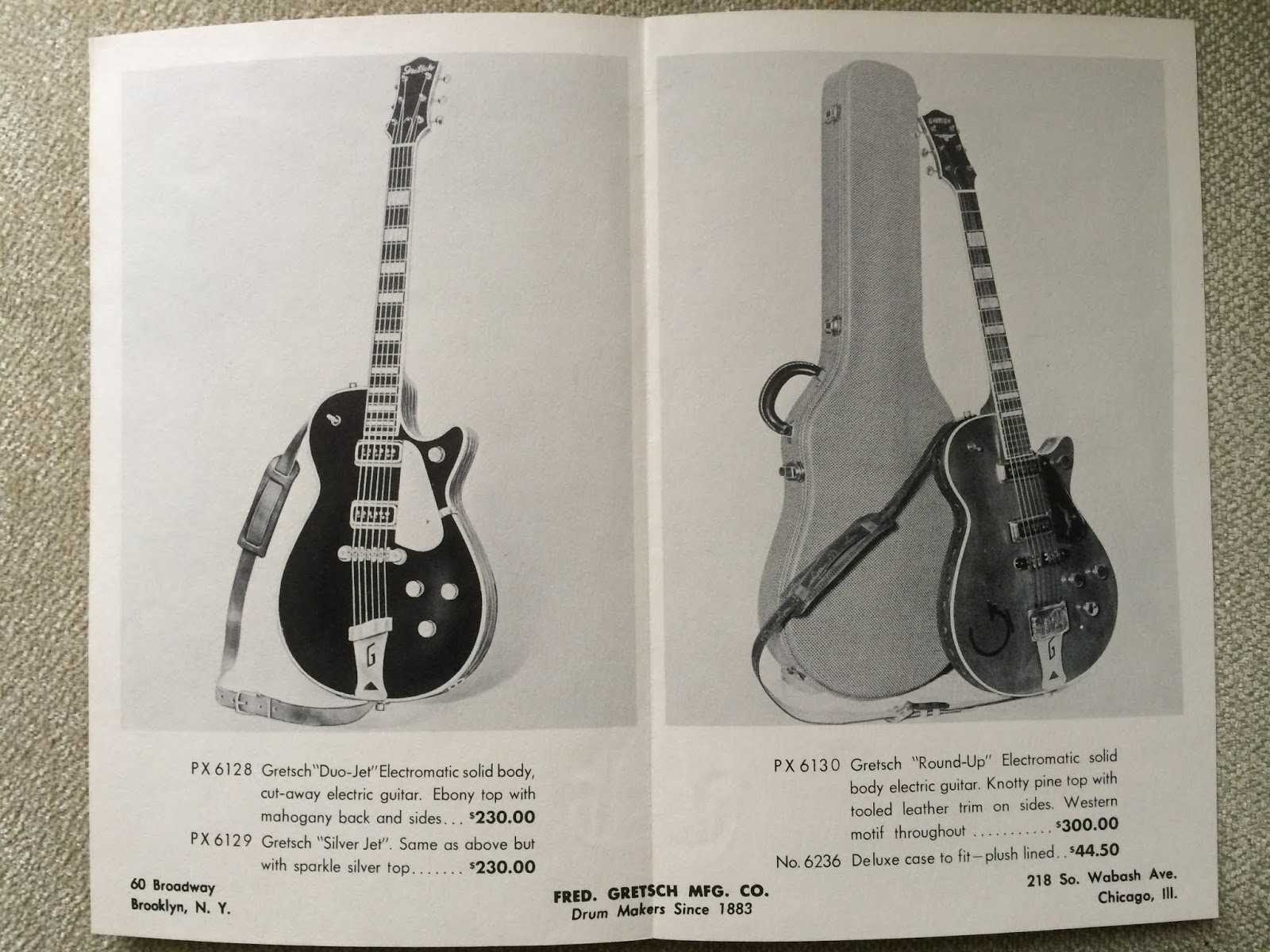
After I first published this article, it was brought to my attention that the stock price of a 1954 Duo Jet was $230, and that in a rare catalog insert (one I had never seen!) from November, 1954--the hard case was listed at $44.50.
$230 plus $44.50 equals $274.50. As much as I wanted the guitar I just found to match the loan document for Cliff's guitar, I had to concede--it was much more likely that the total sale price of the guitar was for the guitar and CASE, rather than the guitar and Bigsby Vibrato.
The original part of my belief that this guitar might be Cliff's relied on that theory that his guitar had come from the factory with a Bigsby vibrato, which would be a rare thing, indeed.
I pored over all the known photos of Cliff playing the guitar. It sure seemed as though his guitar must have come with the Bigsby from the factory. Even the photos of his earlier Western band The Virginians showed the Bigsby on the guitar, or so I initially thought:
After I first published this article, it was brought to my attention that the stock price of a 1954 Duo Jet was $230, and that in a rare catalog insert (one I had never seen!) from November, 1954--the hard case was listed at $44.50.
$230 plus $44.50 equals $274.50. As much as I wanted the guitar I just found to match the loan document for Cliff's guitar, I had to concede--it was much more likely that the total sale price of the guitar was for the guitar and CASE, rather than the guitar and Bigsby Vibrato.
The original part of my belief that this guitar might be Cliff's relied on that theory that his guitar had come from the factory with a Bigsby vibrato, which would be a rare thing, indeed.
I pored over all the known photos of Cliff playing the guitar. It sure seemed as though his guitar must have come with the Bigsby from the factory. Even the photos of his earlier Western band The Virginians showed the Bigsby on the guitar, or so I initially thought:

Then, someone even more eagle-eyed than myself on the Gretsch guitar forum pointed out that this one incredibly blurry photograph seemed to show Cliff playing a stock Duo Jet with the non-vibrato "G" tailpiece. Even though the photo was blurry as hell, I had to agree. There were seeds of doubt.

The jury is still out, but I have to agree--looks like a "G" tailpiece, not a Bigsby.


The jury is still out, but I have to agree--looks like a "G" tailpiece, not a Bigsby.

Here's another set of facts that make guys like myself and Ed Ball start scratching their heads: In the November, 1955 Gretsch catalog, the Bigsby vibrato is not listed as an add-on option for the Duo Jet. The Chet Atkins model solidbody guitar Model #6121 and Chet Atkins model hollowbody guitar Model #6120 are listed in the catalog coming automatically with Bigsby vibratos installed.
Gretsch was a company where custom orders were definitely possible through their dealers. The fact that the Duo Jet serial #15694 found in Nashville is stamped "Model 6128-V" with no other holes in the guitar's butt end show that it was certainly possible, if the customer wanted it, to custom order a Duo Jet with an added Bigsby Vibrato. However, if it wasn't listed as an option in the catalogs or price lists, a Duo Jet with a factory Bigsby starts to look like a true rarity--something only a couple people would have ordered.
 |
 |
| Above: The 1955 catalog shows the Gretsch Chet Atkins model coming automatically with Bigsby vibratos added--and a price $130 higher than a stock Duo Jet. Of course, you got "Western Motifs" and gold plating, plus Chet Atkins' signature on the pickguard! |

 |
| Above: The 1955 catalog shows the "Jet" series, including the Duo Jet, Silver Jet, Round-Up and Jet Firebird--but the Bigsby vibrato is NOT shown to be a standard option for these guitars. Any factory Bigsby installation on a Duo Jet, then, would mean the guitar had to be specially custom ordered that way. Subsequently, any option like this not offered in the catalog would be incredibly rare in implementation--probably just a few at most. |
This is where it starts to get REALLY interesting, if these guitar geek details haven’t put you to sleep yet.

Photos of Cliff Gallup’s Duo
Jet show his guitar equipped with not only a fixed-handle Bigsby B-3 vibrato,
it also shows that his guitar was equipped with a Bigsby aluminum bridge, with
a shiny aluminum base.
Many of us are familiar with
the aluminum bridges and aluminum bridge bases that used to come with your
Bigsby vibrato. However, the one you've seen and are probably familiar with is the standard-issue, aluminum bridge assembly that
has pretty much been the same since around 1955 or 1956.


However, the bridge and
bridge base assembly that we are all familiar with (pictured above) is actually the second
version of the Bigsby bridge and bridge base. 99.9% of the Bigsby aluminum bridge bases seen on guitars vintage and new are like the one pictured above, the second version.
The first design of the
Bigsby bridge and bridge base assembly is incredibly rare. Despite the fact that the design was
innovative and it worked well, there were not very many of these bridges
made. The few examples that I have seen
have all been from around 1953 and 1954.
The first version of the
aluminum bridge base used upside down oval head bolts threaded into the bridge saddle. The upside down bolt heads then went into a cast
hole with an aligning slot in the base.
The bridge saddle was flat on the bottom, and the height adjustment
wheels connected solidly with the bridge saddle. The bridge rocked on the oval head of the
upside down bolts. It was a good system,
but for some reason Paul Bigsby abandoned this style of bridge almost
immediately. Today these type of Bigsby
bridge assemblies are insanely rare, with only a handful of examples known to
exist.
 |
| Early 1953-1954 Bigsby Aluminum Bridge assembly with upside-down oval head bolts used as the "rocking" part of the bridge, as found on serial #15694. |

How does this relate to
identifying Cliff Gallup’s Duo Jet? We
can see from the photos that Cliff’s Duo Jet had a shiny aluminum Bigsby bridge
assembly. When I found #15694, it also
had the early style shiny aluminum bridge assembly. When the vibrato and bridge were flipped
over, all were stamped “G” on the bottom.
Ed Ball and myself are still not sure if the “G” stands for Gretsch, or
Gibson, or both, or neither. But since
the bottom of the vibrato, the bottom of the vibrato handle, the bottom of the
bridge base and the bottom of the compensated bridge saddle are all stamped
“G,” it can be safely assumed that this early ’53-’54 era aluminum bridge
assembly was installed with the factory Bigsby vibrato. How many of the other Jets made in 1954 with
Bigsby vibratos also had the shiny aluminum Bigsby bridge and bridge base?


Ed Ball, who has seen more of
these than anyone else, replied: “I’ve never seen another factory Bigsby
installation on one of these that had the aluminum bridge and bridge base, from
the factory.”
Keep in mind we’re talking
early Gretsch and early Bigsby here. The
solidbody Duo Jet had only been introduced in 1953, by 1958 the guitars had a
lot more uniformity and a lot less hand-made aspects that varied from guitar to
guitar.
Almost concurrently, Bigsby
had made the first Bigsby vibrato in 1952, and began marketing them
commercially after his patent was approved in 1953. The early, "fixed handle" versions are
rare. By 1956, when Bigsby came out with
the first swivel handle version of the vibrato, there was a lot more uniformity
and less variation between units.
The crux of these paragraphs
is to state that in 1954, when Cliff Gallup’s Gretsch Duo Jet was made, there
were not hundreds or thousands of examples of these guitars, as many
mass-produced guitars were after Elvis and the Beatles. In 1954, these guitars, as well as the Bigsby
vibrato unit, were hand-made in small quantities. By distilling down the number of Duo Jets
made in 1954 with the same features as Cliff’s, then distilling that number
down to the ones out of that small number that had factory Bigsby vibratos,
then distilling that even smaller number down to the ones with Bigsby vibratos
and early upside-down oval head bolt aluminum bridges and shiny aluminum bridge
bases on them—well, at this point we are talking about an impossibly small
number of guitars. It is not a huge
stretch of the imagination to say that only one guitar had all those features.
When you take that fact, in
conjunction with the fact that the guitar recently found in Nashville shared
four out of the five digits of the serial number, and a financing document with
dodgy handwriting on the fourth digit of the serial number, that’s when things
really start to get really squirrely.
SPOILER #2 (UPDATE):
As much as I would love to think that Cliff's guitar had a factory Bigsby, I now think that it probably didn't, which means that the guitar I just found in Nashville was definitely not Cliff's missing guitar.
As much as I would love to think that Cliff's guitar had a factory Bigsby, I now think that it probably didn't, which means that the guitar I just found in Nashville was definitely not Cliff's missing guitar.
There are not very many
photos of Cliff Gallup with his Duo Jet.
There are only three professional studio shots of Cliff with his Duo Jet,
and another six photos taken at gigs, or in the studio. Nine photos of Cliff with the Duo Jet, total. (Keep in mind Joe Carducci has one unpublished photo he's saving that shows the second Duo Jet) That’s not very many photos for a major label
recording artist who played on hit records, and it doesn’t leave us much for
photographic detective work.
Here is every known photo of Cliff Gallup with his Gretsch Duo Jet (save for the one mentioned above that Joe Carducci has in his possession):


Below: Cliff with Gene Vincent and the Blue Caps, sans guitar:


I am pretty sure that the guitar I found in Nashville is not Cliff's guitar. And yet--there’s the “17th
fret anomaly.”
Glenn Damato is a hardcore collector and good friend
based on the East Coast. He kindly made high resolution 1200 dpi scans of two
original 1956 Capitol Records 8X10 glossies that he owns of Gene Vincent and
the Blue Caps featuring Cliff Gallup.
The details revealed in these scans are amazing, especially the one below:

I began staring at the
photos, trying to find some unusual detail that would help identify Cliff’s
guitar. Unfortunately, the part of the
guitar that would help the most to see in high definition was the headstock
inlay, and neither photo showed the headstock inlay clearly enough to be
helpful.
I blew up the photo as large
as my computer would let me, and finally one thing caught my eye—a slight
anomaly in the fretboard on the 17th fret. Where all the other inlays were rectangular,
the 17th fret inlay appeared to be slightly trapezoidal along the
bottom edge. As these were hand cut and
hand inlaid, it wouldn’t be unusual for slight anomalies to be present in some
of the inlays from guitar to guitar.
After I saw the anomaly in
the 17th fret inlay in the blown up photo, I looked at the guitar I
had recently found in Nashville. There
on the 17th fret was the same anomaly. The inlay was rectangular on the top, with a
trapezoidal angle on the bottom edge of the inlay.
 |
| 17th fret "anomaly" found on both Cliff's guitar in vintage photo and serial #15694 found recently in Nashville. |
I understand those who read
this and think that this is all just wishful thinking. I admit that I’m a Cliff Gallup fan, and that
in itself should probably disqualify me from the title of “impartial
researcher.” There’s no doubt that I
would love for this to be true. I
understand those who doubt.
This is not a clean, tidy
story. This is a messy way to arrive at
this conclusion. It involves belief in
human error and a mathematical distillation of odds to arrive at this
conclusion. But I do think that the
rarity of this particular guitar, made during this time frame, against the fact
that four of the five digits of the serial number are the same as the serial
number we believed to be Cliff’s make this a hell of a coincidence. I also know that an old guy working in a
music store might not be extra diligent when filling out serial numbers on some
guitar loan paperwork. There's definitely a chance that #15694 MIGHT be Cliff Gallup’s original
Gretsch Duo Jet.
Someday, Gretsch serial
number #15654 is going to turn up. If
that guitar turns out to be a Duo Jet with a Bigsby vibrato on it, or evidence
of once having a Bigsby vibrato on it, at that point we can all say THAT is
Cliff’s guitar. I’ll have no problem
with that.
But I still think there's a small chance that when Gretsch
Serial #15654 turns up, it’s going to be something weird--a Burl Ives Model
acoustic, a Tenor Jet, a Round-Up, a Silver Jet, or a Duo Jet with no signs of ever
having a Bigsby installed on it. It’ll
be something wrong that won’t fit the narrative.
If that happens, heads will
snap to the left, like Wile E. Coyote in an old Roadrunner cartoon, and those same doubters
will remember this odd story about the wayward Gretsch Serial #15694 with all the
right Cliff Gallup features.
When I first bought the guitar in Nashville, I was 90% sure that I had somehow stumbled upon Cliff Gallup's original Gretsch Duo Jet. I still think there's a slight chance, but I think there's a lot of "if's, buts and maybes," too much doubt. There's enough doubt to lead me to re-evaluate my position and say that it probably is NOT Cliff's original guitar.
However, what's pretty amazing about this journey of discovery was finding out just how rare that batch of 1954 Duo Jet's were, and how much rarer that batch was with added Bigsby vibratos on them. Even if the one I found isn't Cliff's, it's pretty amazing to me that it's from the same batch with all the same features, and best of all--it plays and sounds amazing.
I hope that the search for Serial #15654 continues, and I hope that it turns up. We won't really know the answer until that happens, so keep your eyes open!
However, what's pretty amazing about this journey of discovery was finding out just how rare that batch of 1954 Duo Jet's were, and how much rarer that batch was with added Bigsby vibratos on them. Even if the one I found isn't Cliff's, it's pretty amazing to me that it's from the same batch with all the same features, and best of all--it plays and sounds amazing.
I hope that the search for Serial #15654 continues, and I hope that it turns up. We won't really know the answer until that happens, so keep your eyes open!
Deke Dickerson
Northridge, CA
November, 2018

Special thanks to Ed Ball,
Joe Carducci, Glenn Damato, Mark Lee Allen, Dickie Harrell, Lowell Fayna, Darrel Higham, Chris
Scruggs and others who have helped me in this research.

